
My wife and I will likely celebrate Thanksgiving by ourselves. Both sets of parents died years ago and we have no children. Our extended families live in different zip codes and time zones. With me still hobbled by a post-surgery walking boot, we’ll stay home or share time with nearby friends.
But still, it’s Thanksgiving.
President Lincoln pronounced it a national holiday in 1863, though it’s a celebration with traditions that began before the signing of the Declaration of Independence. The factual history of Thanksgiving’s genesis will always be incomplete. As a child, having learned a little, having been told a little, I romanticized the generous Indians sharing a dinner with the bumbling but kindhearted Pilgrims. A nice, tidy myth.
I am no longer that child. I have continued learning about my nation’s wonderful and troubling history. The first known day officially set aside for Thanksgiving occurred in 1637. John Winthrop*, the Massachusetts Bay Colony governor, wanted to celebrate the massacre of and victory over an Indian tribe. Winthrop also personally enslaved indigenous people. The Declaration of Independence I mentioned? That revered document included a reference to “the merciless Indian savages.”
As I noted: wonderful and troubling. But Thanksgiving has continued to evolve.
Food never eaten at other times is served. With my extended family, someone somewhere will prepare broccoli casserole . . .
(Hey, what’s one of your favorite Thanksgiving dishes?)
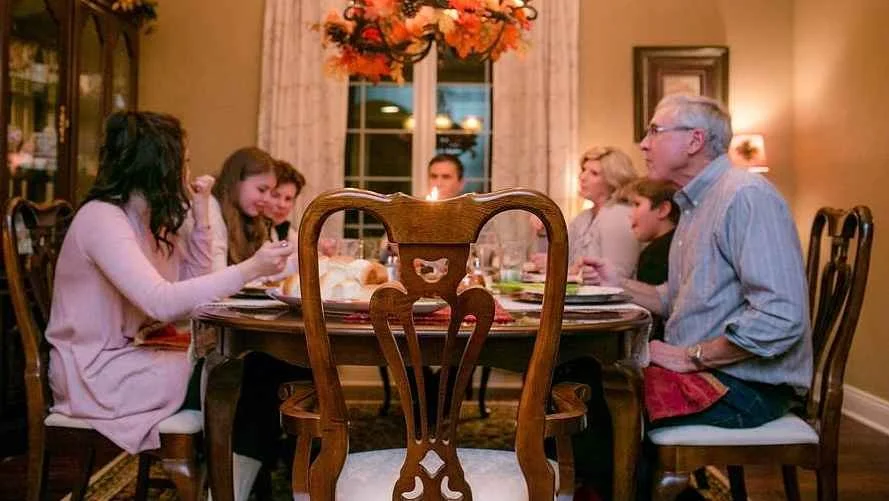
Strangers and families gather around a table. Old and new stories get shared. Bad jokes are repeated. Harsh comments about politics and football spur shouting matches or silent glares. Kids giggle at a kids’ table. Perhaps someone will loudly proclaim they’re now a vegetarian. Engagements are announced. A relative will be grateful his cancer is in remission. Another relative won’t reveal a recent miscarriage. We delight in the embrace of a favorite aunt. We fight back tears because a beloved’s death has left an empty chair. We laugh together at the embarrassing family stories. The best and worst forever mingle at the table.
Thanksgiving serves up memories. For me, even when young, broccoli casserole represented an excellent example. What kid likes vegetables in general or broccoli in particular? And yet there I would be, days before Thanksgiving, anticipating the drive to Aunt Dottie’s and Uncle Earnie’s home for a family buffet and that strangely scrumptious dish. I’ve since made it myself, but it never rivals the legendary taste of Aunt Dottie’s concoction.
Mostly alone this year, with my wife and our aging cat and newly added kitten, I think of a few folks whose lives touched mine. They crowd ‘round my memory table. None were part of any formal Thanksgiving, but I am forever influenced by their voices.
I recall the man who came to my church office, having made an appointment to see me without providing details about why. He was a leader in the town where I served a small church. I was his pastor. He spent nearly all of our time together crying, sharing terrible thoughts and shameful secrets. All I could do was listen. All I could do was grasp his hand. There were no easy answers to what tore him apart. But in sharing, in the words and tears that flowed, I was with him when he took a step toward honesty and healing.
I recall the teenagers, four or five of them, who appeared at my church’s door. They were runaways. A hundred miles and a bus ride from their homes, they realized they’d made a mistake. Out of money, scared, and in a strange place, they were desperate to return home. We phoned their families. We fed them. By the next day, they were headed back. Part of my faded memory of those teens includes asking a member of the congregation to go to the church’s parsonage to help my wife when the runaways arrived to eat and sleep. Because of an obligation, I couldn’t immediately be home and didn’t want my wife to deal with our “guests” by herself. The church member said yes, no questions asked. His generosity eased my concerns.
I recall the stranger who arrived between Thanksgiving and Christmas. He begged the church secretary to see a pastor. As he uncomfortably settled onto a chair, my cynicism warning bell rang. I assumed he’d want money. But he didn’t. He openly confessed about his addiction and failures. He wanted another to listen. And I did. I offered to help him get a motel for the night. He refused. I mentioned several church members involved in a twelve-step program who’d be willing to give support. He refused. At one point, he shared how much he loved his mother and yet always disappointed her. He hadn’t seen her for months. What if we contact her, I asked. At first silent, he nodded and muttered her number. I called, introduced myself, and handed him the phone. They talked. He wept. He’d go home for Christmas. Did I help him? God knows, I don’t know. But he needed to confess. He needed to try again to be with family.
In Thanksgiving, I am embraced by memories. I believe each of us carries hidden wounds. Many are scared and in a strange place. Too often, we view ourselves as disappointments.
We need others. To listen. To share. To be at a real or imagined Thanksgiving table and to feel welcome.
Thanks for reading. More next week . . .
in Peace,
Larry Patten
*Winthrop was also the inspiration for President Ronald Reagan’s “shining city on a hill” imagery about the United States. Reagan used Winthrop’s words in his farewell address to the nation (and in other speeches).