
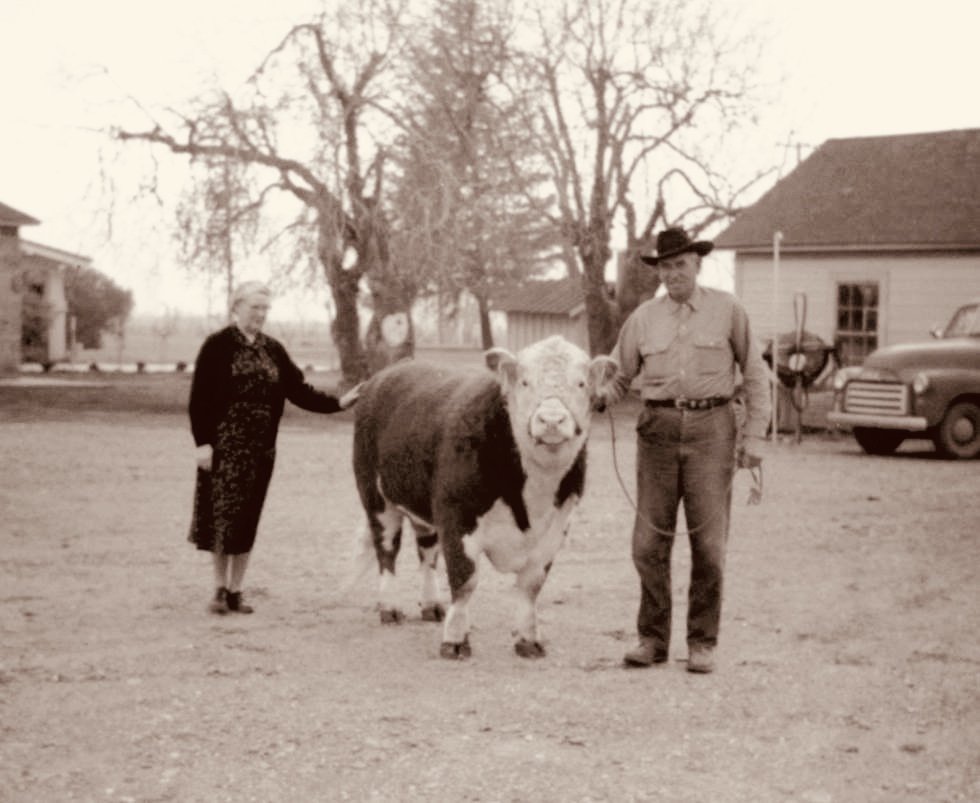
Traveling to my grandparents’ ranch meant a two-and-a-half-hour drive from where I lived in a Sacramento suburb. My earliest memories were when Eisenhower was president. From Highway 99, we’d arrive at Merced, zigzag through a few city streets, and then enter a wondrous expanse of open land. From the back seat, I saw fields with cotton growing and the distinctive white faces and red bodies of Hereford cattle grazing as the narrow two-lane road played tag with the meandering Bear Creek. With 150 acres of mostly flat land, the ranch included chickens, a huge garden, fields of rotating crops, and an orchard of walnut trees. And Herefords.
At a spot where the creek and the road nearly kissed, we turned left onto the long, straight drive to the ranch house. I loved visiting where Grandma’s dinners threatened to break the table with abundant food and Grandpa’s handling of his cattle herd made him appear to possess mystical powers.
For a kid in elementary school, it seemed idyllic, a place of endless discovery.
The ranch was where I had my first kill.
On numerous visits, I stalked the fluffy cottontail rabbits that scurried around the barn and corrals. Imagining myself a mighty hunter, like David preparing for Goliath, I collected pebbles and even fist-sized rocks as weapons. Unlike David, I had no leather sling. Only my throwing arm. The wild rabbits were fast; all I had were near misses—which fed the urge to keep trying.
Until one day when my parents and older sister were ready to return home. Though the car was packed, I wanted one last throw. Another one last throw.
My rock landed.
A rabbit sprawled near a fencepost, writhing on the ground. My make-believe hunter’s instincts were replaced with guilt. The once free-spirited animal was broken, legs uselessly jerking.
I ran to find my father. I don’t remember what I said or his reply. But I do recall his stern gaze, his disappointment. However Dad phrased it, he told me to put the creature out of its misery.
On that day, I used one final rock, as large and heavy as my sorrowful heart.
For much of the drive home, I curled into a corner of the back seat, sniffling and crying.
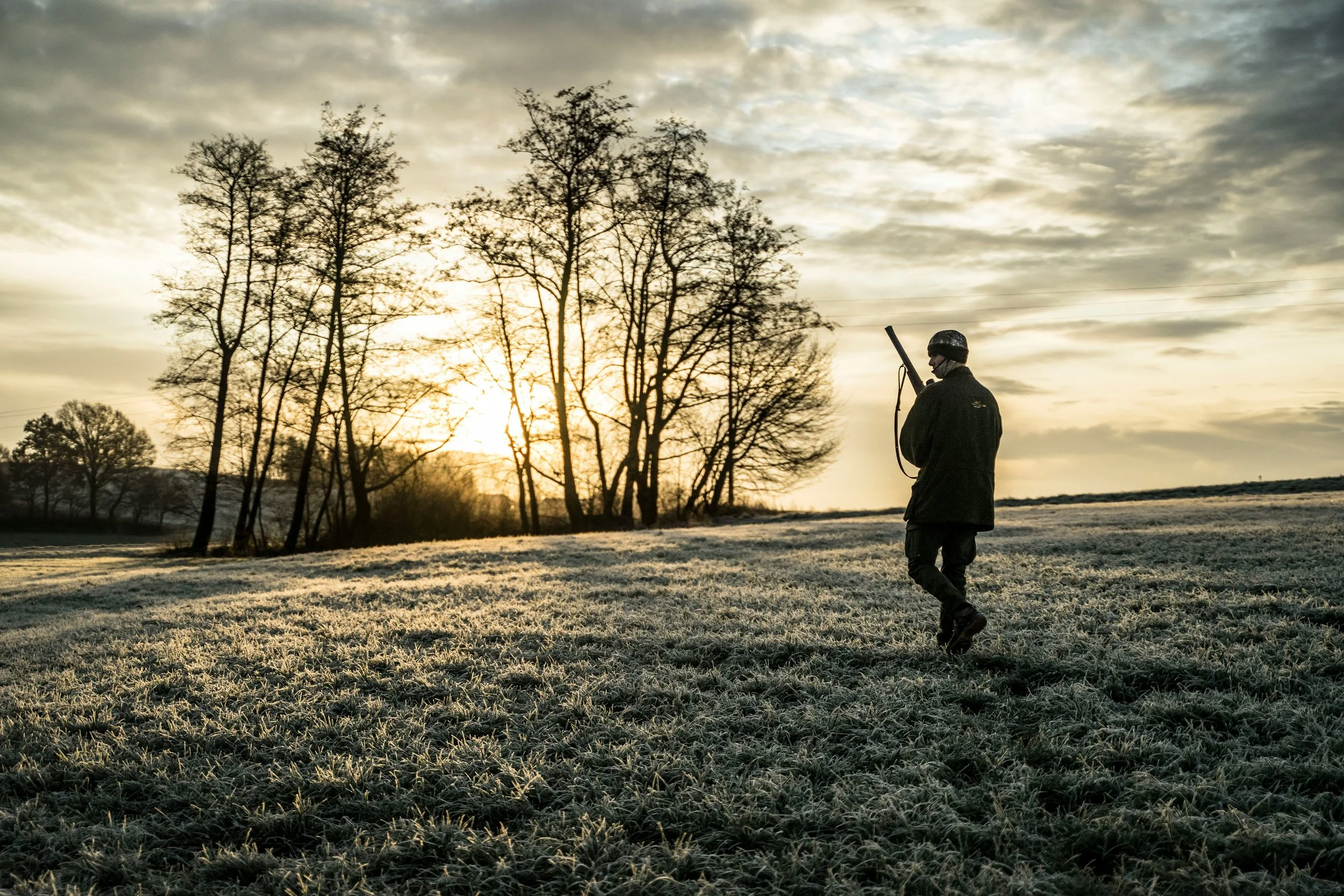
That rabbit was not the last creature I killed at the ranch. Dad taught me how to use a shotgun and we’d hunt for pheasants in the empty pastures. With the Sierra Nevada Mountains framing the eastern horizon and in shouting distance of Bear Creek, we prowled the fields, eyes alert, guns ready. I gripped a hand-me-down .410, the lightest of shotguns. Dad carried his 16-gauge. As emotionally hard as it was to kill that rabbit when younger, the time with my father, alone beneath the autumn sky, exchanging quiet words, striding in tandem, were precious times.
I don’t remember how often we hunted. Whether a few or many, I succeeded only once and shot a bird that had taken wing a few strides in front of me. With Grandma’s help, we prepared the pheasant for dinner. To this day, I can feel my teeth bite down on a shotgun pellet still tucked in the bird’s flesh.
My killing ended with that meal.
+ + +
By the time I entered high school in 1966, a different kind of killing became a daily experience through newspaper headlines and television broadcasts. Young men, a handful of years older than me, were dying in Vietnam. The images and stories were increasingly brutal. We killed X or Y number of Viet Cong. We lost X or Y number of troops. Journalist Walter Cronkite famously visited Vietnam in early 1968, openly questioning the reasons for the war. Cronkite’s doubts influenced many. American streets were bloodied with protests. Dad, a veteran of World War II and lifelong Republican, muttered harsh words about the meaningless conflict. It would not be until 1975 that the last helicopter departed the American Embassy in Saigon.
Was the brutality of Vietnam the reason I no longer had any interest in guns or hunting? Probably. Did the killing of a rabbit contribute to my understanding about the fragility of life and the power I carried? Definitely.
The killing wasn’t only overseas.
How did I react to the 1966 University of Texas Tower shooting where fifteen were killed? How did I react to the 1986 shootings at the post office in Edmond, Oklahoma where fourteen co-workers were killed and the phrase “going postal” became a grim addition to the lexicon? I know, after Columbine in 1999, with fourteen more students and teachers dead and twenty wounded, I stopped playing video games with digital guns and bullets. Before Columbine, I’d enjoyed the first-person-shooter game Call of Duty hundreds of times. After that massacre, I never played another video game.
A week following the school shooting in Bend, Oregon on October 15th of this year, I watched the first interview with the father that entered Silver Rail Elementary School. He would kill the sixteen-year-old shooter. He shared what he remembered. He talked with anguish about killing a kid. He talked about the heroism of a teacher who, with her hands and a cellphone as weapons, attacked the shooter. He talked of “saving the babies.” He talked of his grief over not saving the ones already dead in the classroom.
I have no interest in arguing the value of what a good person with a gun can do versus a bad person with a gun. Every school shooting, every mass murder where bullets have been fired into flesh, creates heroes and villains and, worst of all, victims. Everyone’s a victim when guns are fired. Victims that feel helpless and hopeless. Victims that grieve. Victims when we become numb to the violence that saturates our society.
On my Facebook page, the day after Bend, Oregon I wrote about the father who saved the children and the teacher who tried to stop the slaughter and the three children and one teacher who were shot and killed and that it became the fifty-second mass shooting on a campus in the United States in 2026.
I also wrote that on the same terrible day, when kids in a classroom were threatened by another kid in their classroom, there were other gunshots fired across the country.
Every day, seventy-five (75) people use a gun to end their life. Suicide by gun* is a commonplace tragedy in America. Along with Greenland—of all places—the United States has the highest percentage of gun-related suicides in the world.
Every day, forty-one (41) people in the United States are murdered by a gun. Based on our national average, the day the children were killed in Bend, forty-one others died by gunshots. The next day, forty-one more. And the next day. And the next day . . .
Why are we Americans so violent?
So fearful?
So angry?
Why do we so easily cast stones and shoot guns?
I am that kid running to find Dad and he tells me, with words I can’t recall but with a feeling that remains an open wound in my soul, that I must be the one to put the rabbit “out of its misery.” I am the one responsible.
If only murders and suicides by gun are counted, five people die every hour in America. Day after day. Year after year. What a miserable national fact.
When will we take responsibility for ending this carnage?
Thanks for reading. More next week . . .
in Peace,
Larry Patten
*Over 50% of all suicides in the U.S. are by gun.
Top photo: Julian Hanslmaier on Unsplash
Photo: My grandparents at their ranch