A Blip in Time
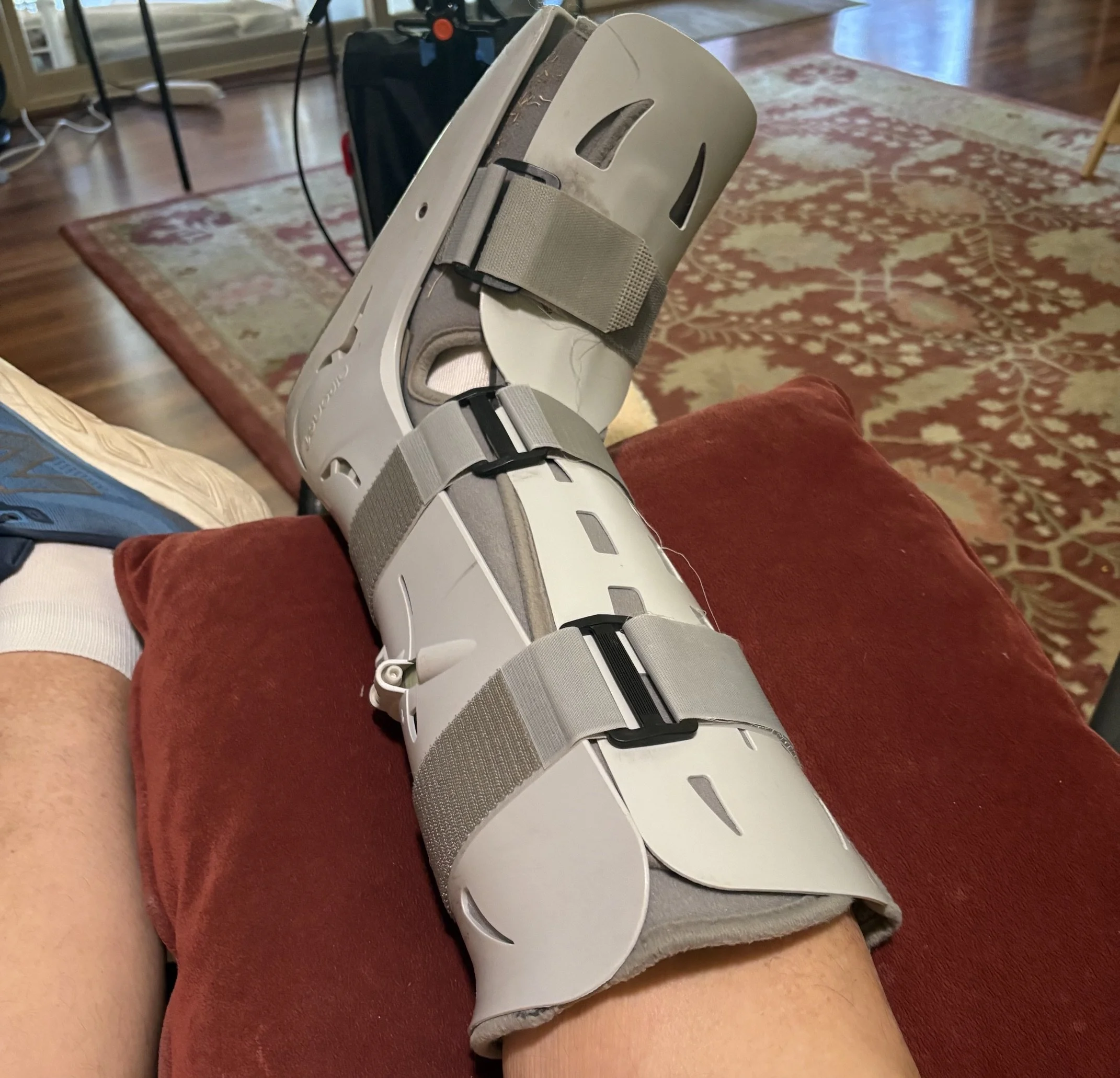
I am a citizen in the land of limitations.
My wife, who can be bluntly optimistic, reminds me that my surgery and six weeks of recovery will soon seem like a “blip in time.”
She’s right.
Still, I frequently sigh.
I mutter and complain.
I glare at the calendars and clocks that seem to circle me like Steven Speilburg’s velociraptors in Jurassic Park and fret over this hour or day never ending.
Going to the bathroom when unable to use my right foot is a mental and physical chore. I don’t want to put myself into a position to have to “rush” to the bathroom. Once there, I have to remember a series of steps, twists, and essential movements that will lead to a successful conclusion of my, er, business. After severely breaking my left leg on a backpack in 1982, the cast that held my limb together extended from hip to foot. I can’t recall how I maneuvered around the throne room during that long-ago “blip in time.” But I did. Didn’t I?
To borrow from Star Trek, it’s hugely limiting for my prime directive* to be: “Don’t put weight on my right foot.”
We humans adapt. We’re clever and curious. We can accomplish new things at eight or eighty years of age.
However.
This particular blip in time is another reminder of what I learned during forty years of ministry: I can’t control everything.
Even in the smallest congregations I served—like Lamont, Wisconsin, a church with maybe forty members that met in the only building at a crossroads surrounded by dairy farms—a lack of control was a regular obstacle.
At a trustees meeting, a person mentioned the church needed a new water heater. In Wisconsin, anything relating to heat is essential.
“Let’s buy one,” I probably said.
“Well, we can’t,” said a trustee.
“Of course, you can,” I probably said, and then I might’ve added, ignoring the emphasis he’d put on the word we, “The trustees are responsible for the property.”
“No,” another trustee quietly said. “Pastor, you’ve got to talk to the women.”
Ah-ha!
In that rural church in Wisconsin’s dairyland, I learned that the women’s group controlled most of the money. Some families contributed to the offering every Sunday; some couldn’t. The trustees had a few line items in the church’s tiny budget for modest repairs. But it was the women who did the Christmas bake sale and the summer picnic for the entire Lamont community and ran the annual raffle to sell homemade goods. The women had money. And they weren’t just “the women.” When talking to them, I needed to understand who was overly thrifty and reluctant to spend their savings and who needed precise details for any decision, and so forth. Sure, I was their pastor, in charge of the church. But I felt out-of-control quite often.
My final years of ministry were in hospice care. As I served dying patients and those who were grieving loved ones, control played a role in every conversation. Daily, control was being stripped away for someone with six months or less to live. Some patients spent their time arguing with caregivers or refusing to eat certain foods or claiming they could still go to the bathroom on their own. They resented losing control. If that meant refusing food or crawling to the bathroom, that was their line in the metaphoric sand. Research from Oregon, a state with legally assisted dying since 1997 (the Death with Dignity Act), has shown that those considering a physician-assisted death lamented their loss of independence and wanted control over what would be their last action. Many took a final breath without using the fatal medication, but having it available gave them . . . control.
My temporarily bad leg is not life threatening.
I am not refusing any food my wife prepares.
In this blip of time, I try to control the little I can in the best ways possible, and to relinquish control on the lot I can’t do.
Please let me remember these “life lessons” when I’ve stored away the knee scooter and returned to walking on two legs.
Thanks for reading. More next week . . .
in Peace,
Larry Patten
* Starfleet “is not to interfere with the development of a culture that is living and growing.”