To My Fellow Suckers
Which of the statements below are true/false:
Journalist Barbara Walters publicly condemned Jane Fonda’s, a.k.a. Hanoi Jane, actions and beliefs about the Vietnam War.
Mary Anne Trump, President Trump’s mother, said, “Yes, he’s an idiot with zero common sense and no social skills, but he is my son. I just hope he never gets into politics.”
Most, if not all, Democrats want the United States’ border to be open.
Among the earliest warnings about the reliability of information on the internet were prescient comments from President Abraham Lincoln.
19th century showman, Phineas Taylor Barnum claimed, “There is a sucker born every minute.”
Your answers are . . .?
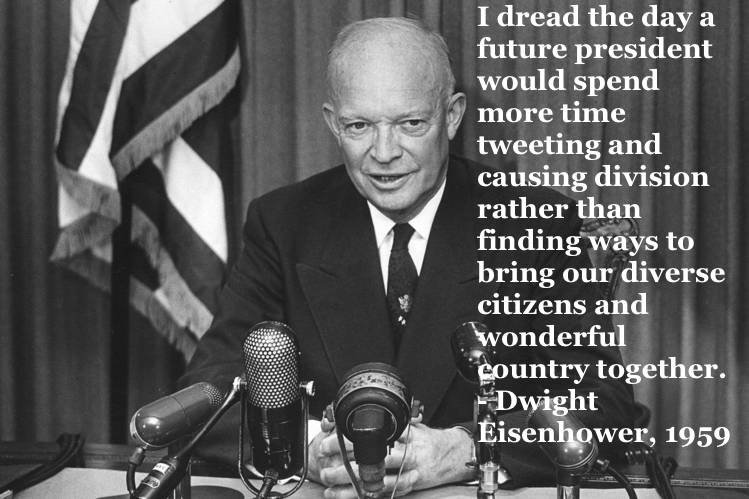
Last week I did something, well, silly. While searching for a photo, I stumbled onto a meme I’d created during President Trump’s first term. The meme—one of the few I’ve ever made—is the top photo for this week’s musings. Its unexpected re-discovery inspired me to use the photo and quote again. Sorry, President Eisenhower.
I posted it.
I chuckled. Such a funny guy I am.
I fussed around with this and that for a few minutes and then reopened my Facebook page.
Whoa!!
Within seconds of appearing, all kinds of different folks were responding to I-Like-Ike’s concerns about tweeting and future presidents. While miniscule compared to the number of comments the famous (or infamous) get, it seemed a stunning response on my digital home in the Facebook neighborhood. A few folks caught the joke, but there were also the predictable accusations about me being disease-ridden with TDS. Others wondered why a jerk like me would put a LIE up on the world wide web.
Few of the rapid-fire reactions were from known Facebook friends.
I only have vague ideas about how the social media platforms work. Which leads to this question: How can something be posted in one second, and then—mere seconds later—angry emojis or thumbs-up support or belittling (and randomly profane) responses swarm beneath my original meme?
+ + +
1. False Journalist Barbara Walters condemned Jane Fonda’s, a.k.a. Hanoi Jane, actions and beliefs about the Vietnam War.
2. False Mary Anne Trump, President Trump’s mother, said, “Yes, he’s an idiot with zero common sense and no social skills, but he is my son. I just hope he never gets into politics.” [See photo at end of musing.]
3. False Most, if not all, Democrats want the United States’ border to be open.
4. False Among the earliest warnings about the reliability of information on the internet were prescient comments from President Abraham Lincoln.
5. False 19th century showman, Phineas Taylor Barnum claimed, “There’s a sucker born every minute.”
So, how’d you do on my quiz? If I was a nice guy, I’d link source material to each of the five statements. But you should look ‘em up yourself. The first four, from Barbara Walters’ take on Hanoi Jane to the silliness of Lincoln’s internet comment are blatantly false. It only takes several clicks of a mouse or scrolling on your phone to reveal their duplicity.
I suppose #5 is debatable. P.T. Barnum, the American showman, may have expounded on the frequency of suckers being born. But the phrase didn’t originate with him. Do you doubt me . . . look it up!
I recall a 60 Minutes episode during President Trump’s first term. On it, campaign strategies were discussed with a key member of the staff handling elections. He explained that targeting tiny audiences on social media was possible. Tiny? Ten or twenty individuals. Even less. A somewhat generic ad could be created for a social media platform. With minimal tweaking, it’s tailored to someone’s passion (maybe climate change) and appears on their page and one or one-hundred other like-minded individuals. That same ad, with different tweaking, might target those with interests in abortion or immigration or another “hot” topic. The possibilities are endless and can look professional or amateur, funny or serious. Whatever might hook the viewer.
Political advertising has become cheap and easy. As always, ads tickle (or sledgehammer) our emotions. Who needs facts when the goal is to manipulate feelings?
The so-called Daisy Girl commercial during the 1964 presidential campaign represented one of the earliest examples of exploiting feelings:
Was the commercial factual? Nope. Did it mention President Lyndon Johnson’s political foe—Barry Goldwater—in its sixty seconds? Nope. But, in its singular appearance on national TV, how did it make the millions of viewers feel regarding nuclear weapons and who should occupy the Oval Office?
On a lark, I posted a lie about Eisenhower. Within seconds I received scores of responses.
I’m just glad I’m a smart guy. Not gullible. Always suspicious in the best sense of that attitude. This is where you can laugh out loud about me. The fact is, I’m one of those suckers born every minute . . . depending on how the lie is told. In today’s world, it’s exhausting to stay vigilant. The alternative is worse.
Thanks for reading. More next week . . .
in Peace,
Larry Patten
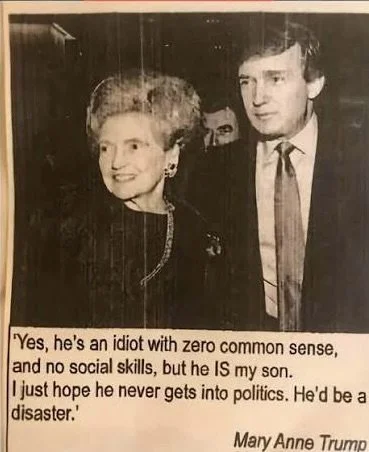
During President Trump’s first term, I saw this misleading picture pop up quite a few times. Yes, that’s Trump and his mother. No, she never said that. Hey, look it up!